How much should I invest?” is the wrong first question. The right one is “what percentage of my income should I invest, and in what order?” — because a fixed rupee number becomes outdated the moment your salary changes, but a percentage-based framework keeps working whether you’re earning ₹25,000 or ₹2,50,000 a month.
This guide gives you a practical, India-specific framework: the order you should follow before investing anything, how much to invest at different salary levels, and how to adjust as your income grows — without falling into the lifestyle-inflation trap that quietly eats most people’s investing potential.
Why a Fixed Amount Doesn’t Work
Generic advice like “invest ₹5,000 a month” ignores the most important variable: what that ₹5,000 actually represents as a share of your income. ₹5,000 from a ₹30,000 salary is a serious 17% commitment. The same ₹5,000 from a ₹1,50,000 salary is a token 3% — nowhere near enough for someone at that income level to build real wealth over time.
That’s why every serious financial framework works in percentages first, then converts to rupees for your specific salary — not the other way around.
Step 1: The Order of Operations (Before You Invest a Single Rupee)
Investing before these three things are in place is a common and costly mistake:
- Clear high-interest debt first. Credit card debt typically runs 36-42% annual interest. No mutual fund will reliably beat that. If you’re carrying a credit card balance, paying it off is your best investment.
- Build a starter emergency fund. Even ₹25,000-50,000 sitting in a separate savings account or liquid fund, untouched, protects you from having to sell investments or take on debt when something unexpected happens — a medical bill, a job gap, a broken laptop you need for work.
- Have basic health insurance in place, either through your employer or a personal policy. One hospitalization without insurance can undo years of disciplined investing.
Once these three are handled, you’re ready to invest with a percentage-based plan instead of investing reactively.
Step 2: The Baseline Framework — Adapted for Indian Realities
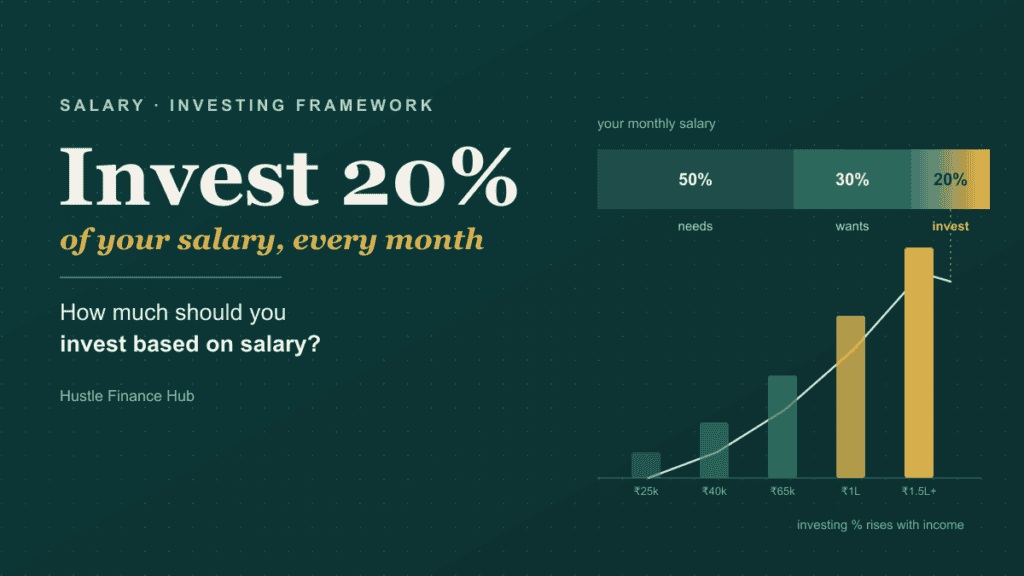
The well-known 50/30/20 rule (50% needs, 30% wants, 20% savings/investing) is a reasonable starting point, but it breaks down fast in Indian metro cities, where rent alone can eat 30-40% of a modest salary. Treat it as a direction, not a rigid formula:
- Needs (rent, groceries, utilities, transport, EMIs, insurance): ideally under 50%, but realistically up to 60% in expensive cities — don’t panic if you’re above 50% here, just don’t let it creep higher without effort to bring it down.
- Wants (dining out, entertainment, subscriptions, shopping): aim for 20-30%. This is almost always the most flexible category, and the one worth trimming first if your needs are unavoidably high.
- Savings + Investing: the floor should be 20%, regardless of city or salary level. If a high-rent city forces your needs above 60%, cut wants down to 10-15% before you cut this number — investing percentage should be the last thing you sacrifice, not the first.
Step 3: How Much to Invest by Salary Level
Here’s a practical breakdown. These are starting points to adapt to your own expenses, not fixed rules:
| Monthly Take-Home Salary | Suggested Investment % | Approx. Monthly Investment |
|---|---|---|
| ₹20,000 – ₹30,000 | 10-15% | ₹2,000 – ₹4,500 |
| ₹30,000 – ₹50,000 | 15-20% | ₹4,500 – ₹10,000 |
| ₹50,000 – ₹80,000 | 20-25% | ₹10,000 – ₹20,000 |
| ₹80,000 – ₹1,50,000 | 25-30% | ₹20,000 – ₹45,000 |
| Above ₹1,50,000 | 30%+ | ₹45,000+ |
The pattern is intentional: as income rises, your essential expenses (needs) don’t rise proportionally — rent doesn’t double just because your salary did. That gap is exactly where your investing percentage should climb. If you’re on the lower end of this table and 15% feels genuinely out of reach right now, start with whatever you can sustain consistently — even 5-8% — and treat the table as where you’re building toward, not where you must start.
Step 4: The Lifestyle Inflation Trap
This is where most people quietly lose their investing potential. A salary hike feels like an invitation to upgrade — a bigger apartment, a new phone, more frequent eating out. None of that is wrong on its own, but if 100% of every raise goes into lifestyle upgrades, your investment percentage silently shrinks every year even while your rupee amount looks like it’s “growing.”
The fix is simple to state and genuinely hard to practice: when you get a raise, increase your investment percentage before you increase your spending. A common approach — split each raise roughly 50/50 between lifestyle and investing, rather than defaulting the entire increase into spending.
Step 5: Where the Money Should Actually Go
Once you know your monthly investing amount, the allocation depends on your goals and timeline, not just your salary:
- Emergency fund top-up (if not yet at 3-6 months of expenses): liquid funds or a high-interest savings account — this isn’t “investing” in the growth sense, it’s protection.
- Long-term wealth building (5+ year horizon): equity mutual funds via SIP — index funds or flexi-cap funds are common starting points for beginners.
- Tax-saving with long-term growth: ELSS funds, if you’re filing under the old tax regime and want a Section 80C deduction alongside equity exposure.
- Guaranteed, lower-risk allocation: PPF or a similar fixed-income instrument, especially useful for goals that can’t tolerate market volatility (a house down payment in 3 years, for example).
A reasonable starting split for someone in their 20s-30s with a long time horizon: the majority into equity mutual funds, a smaller portion into a fixed-income instrument like PPF, with your emergency fund kept completely separate and untouched by market risk.
A Worked Example
Take someone earning ₹45,000 a month take-home in a Tier-2 city.
- Needs (rent, groceries, utilities, transport): ₹22,500 (50%)
- Wants (dining, entertainment, subscriptions): ₹11,250 (25%)
- Investing: ₹9,000-11,250 (20-25%)
At the lower end, ₹9,000/month invested consistently through equity mutual fund SIPs, assuming a long-term average annual return in the range historically seen in diversified Indian equity funds, could realistically compound into a substantial corpus over 15-20 years — the exact number depends heavily on actual market performance, which nobody can predict with certainty. What’s predictable is the direction: consistency and starting early matter more than trying to optimize the exact percentage in year one.
Common Mistakes to Avoid
- Investing before clearing high-interest debt. No SIP return reliably beats 36%+ credit card interest.
- Treating the emergency fund and investments as the same pool of money. Keep them separate — mixing them means market dips can force you to sell investments at a loss exactly when you need cash most.
- Never revisiting the percentage after a raise. Review your investing percentage every time your salary changes, not just once a year on autopilot.
- Copying someone else’s exact rupee amount instead of calculating your own percentage. What works for a colleague on a different salary, in a different city, with different expenses, won’t translate directly to your numbers.
- Waiting for a “round number” salary to start. ₹2,000/month started today outperforms ₹10,000/month started three years from now, purely because of how compounding rewards time over amount.
Frequently Asked Questions
What percentage of my salary should I invest every month? A reasonable floor is 20% of take-home income, adjusted up as your salary grows and essential expenses don’t grow proportionally. If 20% isn’t achievable yet, start with what you can sustain and build up.
Should I invest before or after building an emergency fund? Build at least a starter emergency fund (₹25,000-50,000, or 1 month of expenses) before investing seriously. A full 3-6 month emergency fund can be built alongside your investments rather than fully completed first.
Is the 50/30/20 rule realistic for Indian metro cities? Not always, especially for rent-heavy cities where needs can exceed 50-60% of income. Treat it as a direction rather than a strict rule, and protect the 20% investing floor even if that means trimming the wants category further.
How much should I invest if I get a salary hike? Increase your investment percentage before increasing your spending. A common approach is splitting the additional income roughly evenly between lifestyle upgrades and increased investing.
Should I invest a fixed amount or a fixed percentage of my income? A fixed percentage scales naturally as your income changes and prevents your investing rate from quietly shrinking as your salary grows. Convert it to a rupee SIP amount each time your salary changes.
Stop asking “how much should I invest” as if there’s one universal rupee number. Ask what percentage you can sustainably commit, protect that percentage as your baseline even through raises and lifestyle changes, and let time and consistency do the heavy lifting. If you haven’t started yet, our guide on starting a SIP with just ₹1,000 a month walks through the exact first steps.
Disclaimer: This article is for general educational purposes only and does not constitute personalized financial advice. Investment returns are subject to market risk. Please assess your own financial situation or consult a SEBI-registered financial advisor before making investment decisions