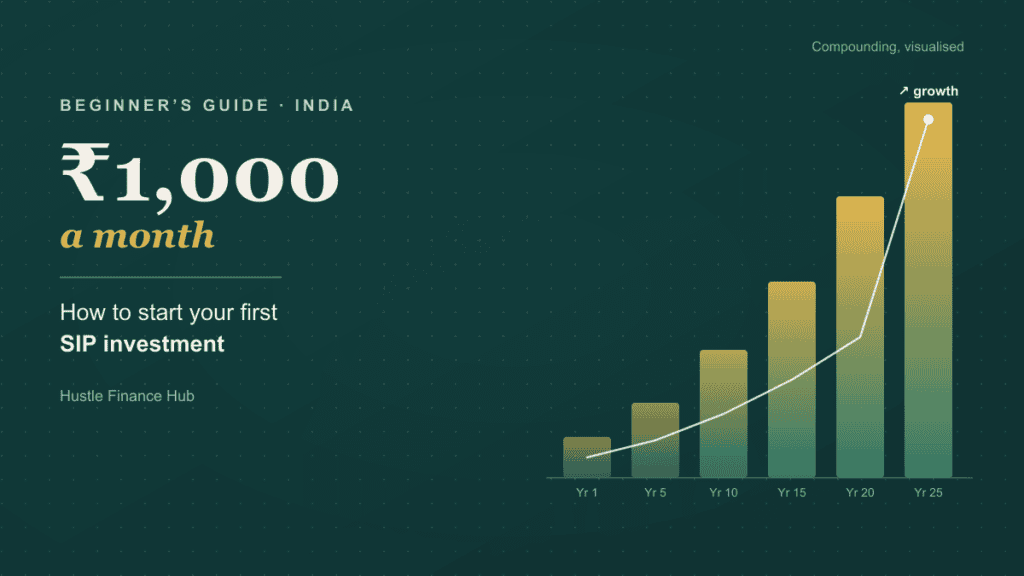
You don’t need a fat salary or a finance degree to start investing. In India today, you can begin building wealth with as little as ₹1,000 a month — the price of a couple of food-delivery orders you probably won’t remember by next week.
This guide walks you through exactly how to start investing with ₹1,000 a month in India: the paperwork you need, how to pick your first fund, a real worked example of what your money could look like a year from now, and the mistakes that trip up almost every first-time investor.
Why ₹1,000 a Month Is Actually Enough to Start
Most people delay investing because they’re waiting to “have more money first.” That’s backwards. The habit matters more than the amount in the early years.
Under SEBI (Securities and Exchange Board of India) rules, mutual fund houses can offer SIPs — Systematic Investment Plans — starting from ₹100 to ₹500 a month, and many well-known funds accept ₹1,000 as an entry point. A SIP simply means a fixed amount is auto-debited from your bank account every month and invested into a mutual fund of your choice. You’re not trying to time the market or pick the “perfect” moment — you’re building a habit that compounds.
Two things work in your favor at ₹1,000 a month:
- Rupee-cost averaging — because you invest the same amount every month, you automatically buy more units when prices are low and fewer when prices are high, which smooths out market ups and downs over time.
- Compounding — even a small monthly amount, left untouched for 10-15+ years, grows far more from time in the market than from the size of the initial investment.
Step 1: Get Your Documents in Order
Before you can invest a single rupee, you need:
- PAN card (mandatory for any mutual fund investment in India)
- Aadhaar card (linked to your mobile number, for e-KYC)
- A savings bank account in your own name
- A cancelled cheque or bank statement (for setting up auto-debit)
If your PAN and Aadhaar are already linked and your KYC hasn’t been done before, this entire step usually takes under 15 minutes online.
Step 2: Complete Your KYC (One-Time Process)
KYC (Know Your Customer) verification is a one-time SEBI requirement for every mutual fund investor. You can complete it:
- Directly on a mutual fund app or website (most now offer instant video-KYC)
- Through your bank’s investment section, if you already have an account there
- Via a KYC Registration Agency (KRA) portal
Once your KYC status shows “verified,” you can invest in any mutual fund in India without repeating this process each time.
Step 3: Choose Where to Invest
You have three broad options:
- Direct plans through the AMC’s own app/website (e.g., the fund house’s own platform) — lowest cost, since there’s no distributor commission built into the expense ratio.
- Investment apps/platforms — convenient, let you compare and invest across multiple fund houses in one place.
- Your bank’s mutual fund section — familiar and simple, but often defaults you into “regular” plans with higher fees unless you specifically ask for a “direct” plan.
SEO/beginner tip: Always choose the “Direct” plan, not “Regular,” when given the option. Over 15-20 years, the difference in fees between direct and regular plans can add up to a meaningfully larger final corpus for the exact same fund.
Step 4: Pick the Right Fund Type for ₹1,000/Month
At this investment size, simplicity beats complexity. Three categories are worth knowing:
| Fund Type | Best For | Risk Level |
|---|---|---|
| Index Fund (e.g., tracks Nifty 50 or Sensex) | First-time investors who want low cost and broad market exposure | Moderate |
| Flexi-cap / Multi-cap Fund | Investors who want a professional fund manager actively choosing stocks across company sizes | Moderate-High |
| ELSS (Tax-Saving Fund) | Investors who also want to claim a tax deduction under Section 80C | Moderate-High |
For a true beginner, a low-cost index fund is often the easiest starting point — it simply mirrors the broader market instead of trying to beat it, and it typically carries one of the lowest expense ratios among equity fund categories.
A Realistic Example: What ₹1,000/Month Could Look Like
Let’s say you start a SIP of ₹1,000/month in a diversified equity fund in January.
- After Year 1, you’d have invested ₹12,000. Depending on market performance, your fund value might land anywhere from slightly below ₹12,000 (in a down year) to around ₹13,000-13,500 in an average year — equity markets don’t move in a straight line, and short-term swings are normal.
- The real story shows up over time, not in year one. If you increase your SIP by even ₹500-1,000 every year as your income grows (a “step-up SIP”), and stay invested through market ups and downs for 15-20 years, historical long-term equity returns in India have generally outpaced inflation and fixed deposits by a wide margin — though past performance never guarantees future results.
The point isn’t the exact number. It’s that starting now, even small, beats waiting for a “better” amount later. Every year you delay is a year of compounding you don’t get back.
Common Mistakes First-Time Investors Make
- Stopping the SIP the first time the market dips. A falling market with an active SIP means you’re buying more units at a discount — that’s the system working, not failing.
- Choosing “Regular” plans instead of “Direct” out of habit or unfamiliarity. Always check which one you’re selecting.
- Chasing last year’s “top performing fund.” A fund that topped the charts last year rarely repeats that exact rank the next year. Consistency and fund category fit matter more than chasing a single year’s return.
- Not automating the SIP. Manual monthly investing relies on willpower. Auto-debit (NACH mandate) removes the decision-making from the equation entirely.
- Ignoring the expense ratio. For beginners, a small difference in annual fees compounds meaningfully over 15-20 years — always check it before choosing a fund.
Frequently Asked Questions
Can I really start investing in mutual funds with just ₹1,000 in India? Yes. Most major fund houses allow SIPs starting from ₹500-1,000/month, and several allow even smaller “micro-SIPs” from ₹100/month.
Is a ₹1,000 SIP worth it, or should I wait until I earn more? It’s worth starting now. The habit and the time your money spends invested matter more in the early years than the amount. You can always increase your SIP later.
Do I need a demat account to start a SIP? No. You can invest in mutual funds directly through an AMC app, an investment platform, or your bank without a demat account, unless you specifically want to hold funds in dematerialized form.
What happens if I miss a SIP payment? Most fund houses won’t penalize you for one missed installment, but repeated failures can lead to the SIP being cancelled. It’s best to keep your linked bank account funded on the debit date.
Which is better for a beginner: SIP or lump sum investing? For most beginners with a fixed monthly income, SIP is easier to sustain and reduces the risk of investing a large amount right before a market downturn.
Final Word
You don’t need ₹10,000 a month or a demat account full of stock tips to start. You need ₹1,000, a completed KYC, and the discipline to let a SIP run untouched for years. Start this month — your future self will thank you for not waiting for the “right time” that never actually arrives.
Disclaimer: This article is for educational purposes only and is not personalized financial advice. Mutual fund investments are subject to market risk. Please read scheme documents carefully and consult a SEBI-registered financial advisor before investing